Joe Burrow Graded Cards — PSA 10, PSA 9, BGS & SGC Slabs Explained
A buyer's map of slabbed Joe Burrow cards: how the PSA, BGS, and SGC scales actually work, what separates a PSA 10 from a PSA 9, how to verify a cert before you pay, and live eBay listings for each graded tier.
Find these cards on eBay
The cards on this list trade on eBay, not Amazon — these open live listings for each one. Buy graded (PSA or SGC) for anything above four figures.
If you’ve searched “Joe Burrow PSA 10 rookie card” you already know the graded market is where the serious money in his catalog sits. A slab answers the two questions that make raw cards risky — is it real and what condition is it actually in — and that’s why graded copies trade as their own tier.
This page is the buy-side map: what the grading scales actually mean, how the tiers differ, and how to verify a slab before you pay. Every button opens live eBay listings so you’re looking at the real current market, not a number someone typed into an article. We don’t publish card values here — the listings do that job honestly.
Already have raw cards and wondering whether to send them in? That’s the opposite question, and it has its own page: Should you grade your Joe Burrow cards?
The three graders, and what their labels mean
PSA — the highest-volume grader in modern football, and the reason its slabs are the most liquid on the open market. Ten-point scale, with PSA 10 (Gem Mint) at the top and PSA 9 (Mint) immediately below. PSA issues half grades below 9 — 8.5, 7.5, and downward — but no 9.5, which is precisely why the 9-to-10 step is the sharpest line in the whole Burrow graded market.
BGS (Beckett) — reports four subgrades (centering, corners, edges, surface) alongside the overall grade, so the label tells you why a card landed where it did. BGS adds a 9.5 Gem Mint tier between 9 and 10, and a Black Label 10, which requires all four subgrades to hit 10. Black Label is the scarcest designation in the graded hobby.
SGC — a ten-point scale in a distinctive black-matted holder, long favored for vintage and widely used for turnaround speed. Its top tier is SGC 10 (Pristine), with a 10 Gold designation above it.
A grade from one company is not mechanically interchangeable with the same number from another. Read the label, not just the digit.
The graded tiers, top to bottom
- Top-pop chrome rookies in a 10 — a Gem Mint 2020 Prizm, Select, Optic, or Mosaic rookie is the headline of the graded market. Chrome stock shows edge and surface flaws easily, which keeps the 10 population meaningfully tighter than the raw print run.
- Graded autographs — a slabbed Contenders Rookie Ticket or a National Treasures RPA carries the two things a signature buyer needs most: authentication of the auto and a condition grade on the card. This is the tier where buying graded matters most, because fake Burrow autographs are a real and persistent problem.
- PSA 9 rookies — the value entry point into the graded market. Same authentication, same protection, a visible step down in grade. For a collector who wants a real, verified 2020 Burrow rookie without chasing the top tier, this is often the sensible buy.
- Numbered parallels in any grade — a serial-numbered parallel in a slab combines print-run scarcity with a fixed condition. The serial number and the grade are two independent scarcity levers stacked on one card.
- Graded paper rookies — slabbed Donruss Rated Rookie and Score cards are the accessible floor. Paper stock is unforgiving on corners and centering, so a high grade on paper is a genuine achievement rather than a formality.
Buying a slab without getting burned
- Verify the cert number. PSA, Beckett, and SGC each publish an online certification lookup keyed to the number on the label. It should return the same player, year, set, and grade the listing claims. A cropped or blurred cert number in the photos is a reason to walk.
- Insist on photos of the actual slab. Front and back, label legible. Stock images on a graded card listing tell you nothing about the item you’d receive.
- Read the grade, not the adjective. “Gem Mint” in a title means nothing unless the label says it. Sellers routinely describe raw cards with grading-company vocabulary.
- Confirm it’s a 2020 card. Burrow’s rookie-card year is 2020 only — every later-year card is a veteran issue no matter how a listing words it. The cards by year page settles that one for good.
- Compare against sold listings, not asking prices. Anyone can list at any number. The buttons above open live listings; filter to sold to see what the market actually paid.
- Mind the population trend. Modern cards keep getting submitted, so graded supply grows over time. Check the grader’s own population report before you treat any grade as scarce — we deliberately don’t quote pop numbers here, because they change weekly.
Where the tools help
- Card centering tool — centering is the one grading criterion you can measure yourself from a photo before you bid on a raw card, or sanity-check on a slab you’re considering cracking.
- Grading ROI calculator — for the other direction: whether a raw card is worth sending in at all.
- Collection value tracker — keep your slabs and their grades logged in one place.
Keep exploring
- New to the chase? Start with the Joe Burrow rookie cards guide or the full 2020 rookie checklist.
- Chasing signatures? Joe Burrow autographs & top cards covers the signed market end to end.
- Wondering about worth? What’s a Joe Burrow card worth? works through live listings.
- Grading a chase card? Joe Burrow inserts & chase cards maps the named insert sets — foil and textured insert stock grades harder than plain paper.
- The whole catalog in one place: the Joe Burrow player hub, plus his team story on the Cincinnati Bengals page.
Products Featured on This List

2020 Panini Donruss Football #301 Joe Burrow Rookie Card - Rated Rookie - Graded PSA 9 Mint
1 owner reviews
2020 Panini Donruss Football #301 Joe Burrow Rookie Card - Rated Rookie - Graded PSA 9 Mint.

2024 Panini Joe Burrow NFL Comeback Player of the Year Card #AW-CPOY - Graded GEM Mint 10
2024 Panini Joe Burrow NFL Comeback Player of the Year Card #AW-CPOY - Graded GEM Mint 10.
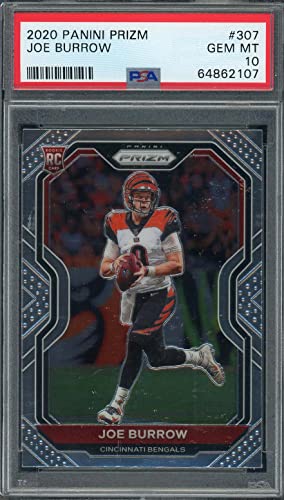
Joe Burrow 2020 Panini Prizm Football Rookie Card RC #307 Graded PSA 10
Joe Burrow 2020 Panini Prizm Football Rookie Card RC #307 Graded PSA 10.

Graded 2020 Panini Select Joe Burrow #246 Rookie RC Football Card PSA 10 Gem Mint
Graded 2020 Panini Select Joe Burrow #246 Rookie RC Football Card PSA 10 Gem Mint.

PSA 10 JOE BURROW & JA'MARR CHASE 2 CARD ROOKIE LOT DONRUSS BENGALS STAR YOUNG PLAYER QUARTERBACK & WIDE RECEIVER GRADED PSA GEM MINT 10
1 owner reviews
PSA 10 JOE BURROW & JA'MARR CHASE 2 CARD ROOKIE LOT DONRUSS BENGALS STAR YOUNG PLAYER QUARTERBACK & WIDE RECEIVER GRADED PSA GEM MINT 10.

PSA 10 JOE BURROW JA'MARR CHASE LEAF 2 ROOKIE CARD LOT GRADED PSA GEM MINT 10 BENGALS STARS LSU CHAMPS
PSA 10 JOE BURROW JA'MARR CHASE LEAF 2 ROOKIE CARD LOT GRADED PSA GEM MINT 10 BENGALS STARS LSU CHAMPS.